Undergraduate Core Curriculum Redesign - Core Area Learning Outcomes
Learning Outcome Final Draft - Updated 4/28/2026
Learning Outcomes Feedback Form
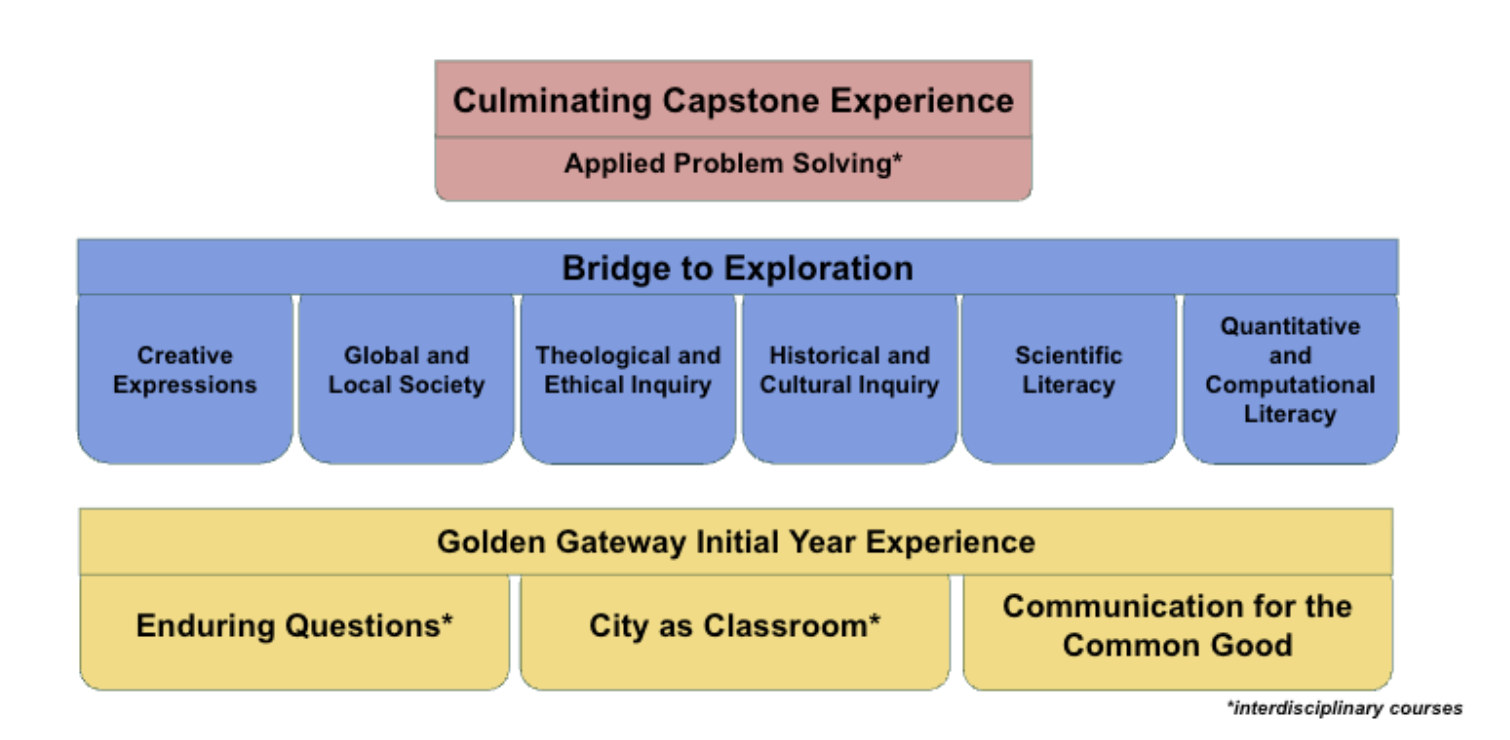
GOLDEN GATEWAY
ENDURING QUESTIONS
- Contend with Big Questions. Analyze how enduring questions about human existence, meaning, belief, and/or responsibility are interpreted and debated within particular traditions and/or disciplines.
- Map Perspectives Across Time and Culture. Compare perspectives and worldviews across cultures, communities, time periods, and/or traditions (both religious and secular).
- Discern Your Own Path. Connect central course themes and materials to your approach to meaning, discernment, and purposeful action.
CITY AS CLASSROOM
- Engage the City. Explore the artistic, historical, social, cultural, civic, economic, or scientific dimensions of the SF/Bay Area.
- Integrate Theory & Practice. Synthesize your direct observations of the city, scholarly sources, and community perspectives to analyze complex issues and construct evidence-based arguments.
- Reason Ethically in Place. Guided by the Jesuit value of cura personalis—care for the whole person—apply ethical reasoning to locally relevant issues, considering multiple perspectives and community impacts.
- Conduct Project-Based Inquiry. Design an independent or collaborative project that applies fieldwork, research, or creative methods to investigate or reimagine a real-world phenomenon situated within the SF/Bay Area, and communicate findings to a relevant audience.
- Know Where You Stand. Reflect critically on your own background, assumptions, and evolving relationship to the SF/Bay Area and its communities, considering how your perspective shapes what you observe, what you question, and what you come to understand.
COMMUNICATION FOR THE COMMON GOOD
- Analyze Language, Power, and Identity. Analyze how communication, technology, and media reflect and shape cultural values, social roles, and power dynamics.
- Communicate with Purpose. Guided by the Jesuit value of eloquentia perfecta—speaking and writing for the common good—apply communication principles to craft and deliver intentional messages in multiple modalities (oral, written, multimedia).
- Critically Evaluate Sources. Critically evaluate scholarly, popular, and AI-generated content.
- Ethically Synthesize Information. Synthesize information, demonstrating ethical, transparent, and responsible use of information, media, and technology.
- Reflect on Your Own Communication Choices. Articulate how your positionality and relationship to power impact your production and interpretation of messages.
BRIDGE TO EXPLORATION
CREATIVE EXPRESSIONS
- Develop a Creative Practice. Conceive, create, and present original artistic work and/or arts-based research that integrates intellectual inquiry and technical skill through visual, written, performed, or other devised forms.
- Understand the Forces that Shape Creative Work. Analyze creative works and practices in their historical, cultural, and formal contexts using established arts-based methods and sources.
- Examine Ethics in Creative Work. Apply ethical frameworks to examine questions of power, human values, representation, identity, and/or justice in creative and arts-based work.
- Develop Imagination and Risk-Taking. Cultivate imaginative inquiry through exploratory and/or iterative processes, demonstrating intellectual curiosity, openness to ambiguity, and a willingness to take creative risks.
- Reflect on Your Creative Choices. Connect creative ideas, choices, and/or processes to personal values, intellectual development, and responsibilities to others.
GLOBAL AND LOCAL SOCIETY
- Engage Theory. Apply theories or theoretical frameworks to analyze human behavior, social or political organization, and/or institutions in local and global contexts.
- Work with Evidence. Evaluate empirical evidence — quantitative and/or qualitative — to analyze contemporary social issues, distinguishing between description, interpretation, and critique.
- Connect Local, Global, and Intercultural Perspectives. Demonstrate intercultural awareness while analyzing how local and global conditions, processes, or forces shape, and are shaped by, the behaviors, experiences, and practices of diverse groups, cultures, and places.
- Examine Social Life Through an Ethical Lens. Apply ethical reasoning to evaluate how social arrangements affect individuals and groups, and consider and/or enact possible responses.
RELIGIOUS, THEOLOGICAL, AND ETHICAL INQUIRY
- Know Core Ethical or Religious Frameworks. Explain and critically evaluate the strengths and weaknesses of foundational ethical theories or religious frameworks (e.g., Buddhism, Christianity, Hinduism, Indigenous Religions, Islam, Judaism, Consequentialism, Deontology, Virtue Ethics).
- Apply Frameworks to Today's Questions. Apply foundational ethical theories, or theological or religious frameworks to contemporary humanistic, social, or moral questions, constructing and defending well-reasoned responses.
- Compare Diverse Paths to Meaning. Investigate and compare diverse ways that individuals and communities make and discover meaning through philosophical, theological, or religious sources.
- Construct Strong Arguments on Religious or Ethical Topics. Communicate clear, well-structured arguments, orally and in writing, about religious, theological, or ethical issues, from inter-religious or inter-philosophical perspectives.
- Situate Your Own Beliefs. Discern and analyze your own religious, theological, or ethical commitments and how these commitments relate to a broad range of human experiences.
HISTORICAL AND CULTURAL INQUIRY
- Read Sources in Context. Examine primary sources, including historical documents, visual materials, literary texts, films, performances, or other media by situating them in their historical and cultural contexts.
- Apply Methods of Interpretation. Apply historical, literary, or other arts-based methods to analyze sources and examine how they may reflect underlying assumptions, interpretive frameworks, and/or differing points of view.
- Analyze Power and Difference. Demonstrate how historical processes and power structures, including race, gender, class, sexuality, religion, empire, colonization, war, and/or migration, have impacted human experiences and cultural expression.
- Construct Evidence-Based Arguments. Develop and communicate original ideas or arguments in well-structured, evidence-based written and/or oral forms.
- Connect the Past to the Present. Investigate how informed interpretations of the past and/or cultural texts relate to contemporary ethical, social, and/or political questions.
SCIENTIFIC LITERACY
- Practice Scientific Inquiry. Investigate natural phenomena through empirical techniques, demonstrating the role of observation and experimentation in the development of scientific knowledge and the scientific method.
- Reason from Evidence. Analyze and interpret data, distinguishing evidence from inference, and evaluating uncertainty and bias.
- Build and Apply Scientific Models. Utilize conceptual, mathematical, or computational models to explain natural phenomena and apply them to new problems.
- Reason Ethically and Responsibly About Science. Examine ethical issues in science and technology, demonstrating a sense of responsibility in applying the scientific method.
QUANTITATIVE AND COMPUTATIONAL LITERACY
- Ask and Answer Quantitative Questions. Investigate questions using mathematical or computational methods, including questions about mathematical structures or real-world systems.
- Model, Analyze, and Interpret. Translate problems into quantitative or mathematical forms, use those forms to analyze patterns or make predictions, and interpret the results.
- Use Structured Reasoning to Solve Problems. Apply systematic methods, including algorithms, simulation or logic, to break down complex problems and find solutions in unfamiliar situations.
- Assess the Social and Ethical Impact of Quantitative Systems. Evaluate the societal impacts of mathematical, computational, or data-driven systems, including their ethical implications.
CULMINATING COURSE: APPLIED PROBLEM-SOLVING
Learning outcomes to be finalized in Fall 2026.
Endorsed by Joint University Curriculum Committee, May 21, 2026.