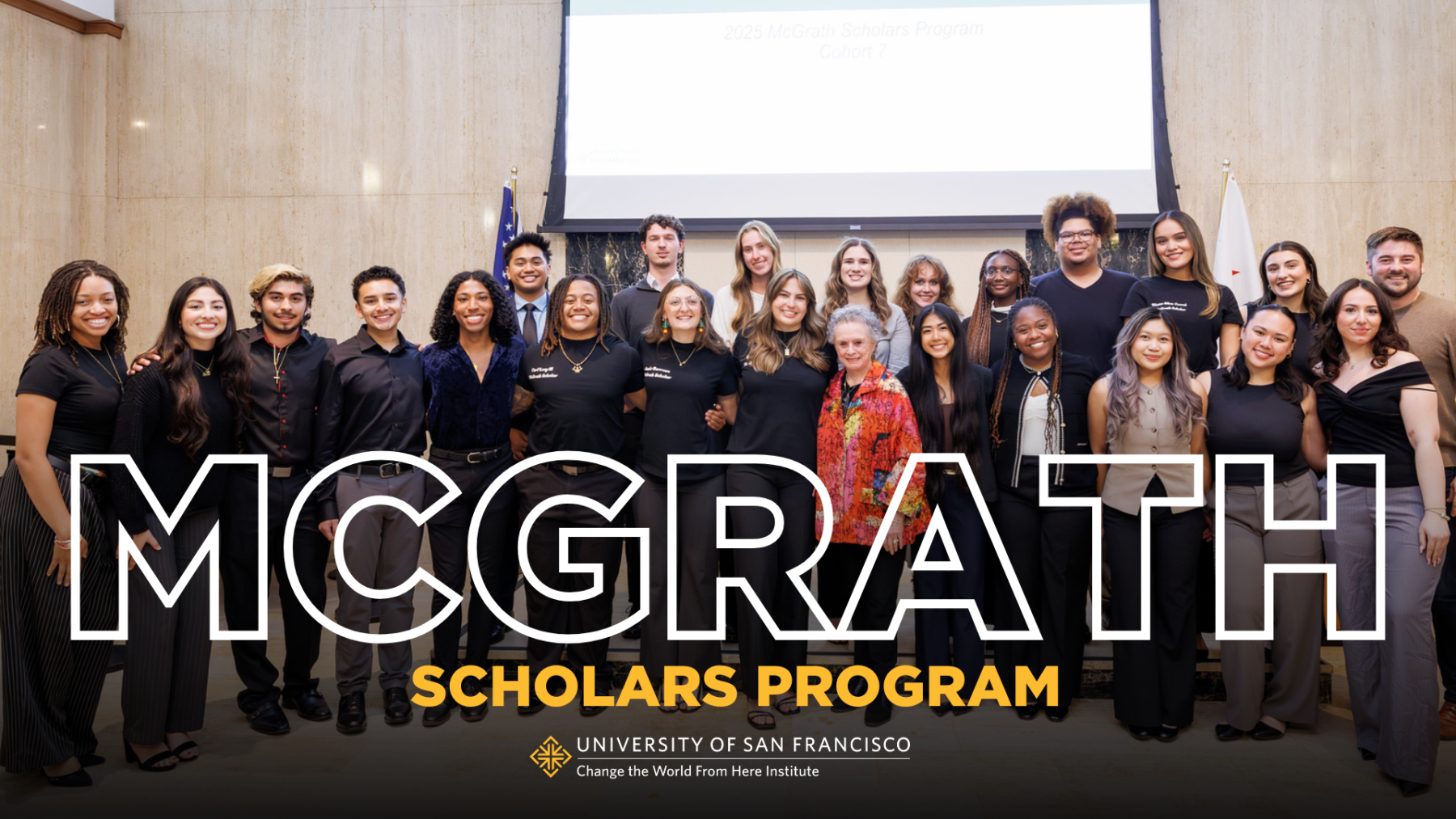
McGrath Scholars Program
INFORMATION SESSION
Wednesday, September 23, 2026
5:00–5:45 PM
Maraschi Room, Fromm
Applications will open Wednesday, September 16, and close on Wednesday, October 7
Start Your Application Here
Our Mission
The McGrath Scholars Program is a leadership opportunity that includes an accelerated two-unit interdisciplinary course for 24 imperfectly exemplary upperclassmen. Each Fall semester, the program recruits and selects individuals who are deeply motivated to explore and apply advanced leadership theory through experiential team capstone projects that address complex local challenges identified by nonprofit partners of the Change Institute. McGrath is the perfect program for those determined to graduate with experience and skills that equip them to navigate complex, challenging, and uncertain spaces with courage, compassion, and hope.
Benefits
The McGrath Scholars Program is an opportunity for students to enroll in a unique, 2-credit leadership course and join an exceptional cohort of peers, further enhance their skills, and engage in an experiential project.
- Resume builder as a McGrath Scholar
- Accelerated short-term class, Monday evenings: January through April.
- Retreat opportunity, two days off-campus in the Marin Headlands
- Enhanced learning through peer-to-peer interactions and networking
- Special recognition as a McGrath Scholar at graduation
Curriculum
The McGrath Scholars complete a two-credit leadership course (USF-300) that approaches leadership through the holistic development of the student via academic lessons, skills and engagement taught through a leadership retreat, and leadership mentoring through peer support.
- Self-transformation
- Vision and Systems
- Courageous Action
- Change and Collaboration
Experiential Learning Outcomes
- Identify and model personal values of integrity and ethical leadership, and engage with those ideas in larger scales and contexts
- Demonstrate key leadership and personal values through community relationship-building with courage and compassion
- Manage ambiguity and work in a self-directed way
- Incorporate creative thinking and innovation in daily leadership practice
- Demonstrate the ability to problem solve and recommend solutions for systems, problems, and issues that challenge the common good
McGrath Scholar Eligibility
USF Juniors and Seniors from all schools and colleges are welcome and encouraged to apply. We consider Juniors and Seniors to be those who expect to graduate within 1 academic year of their participation in the program. For example, if you intend to graduate Spring 2028, you can begin applying either Fall 2026 for Spring 2027 or Fall 2027 for Spring 2028.
All registered Juniors and Seniors enrolled in Spring 2027 will apply in Fall semester 2026. Acceptance into the program requires an essay-based application with a current resume and letter of recommendation and an interview with the course faculty and/or a member of the McGrath Scholars Interview Team.
The cohort of McGrath Scholars will be limited to 24 undergraduate students. To be selected, you must apply and be considered.
Have a question about the program? Email us at: changeinstitute@usfca.edu
Cohort 9 (Spring 2027) Recruitment PROCESS & Timeline
The recruitment process for Cohort 9 of the McGrath Scholars Program begins in the Fall semester. The recruitment process begins with nominations, followed by written applications. Applications are the first round of our selection process, followed by an interview. Not all applicants will be offered an interview. Once interviews have been completed, the Selection Team will convene to determine the next cohort of McGrath Scholars. Below is the recruitment timeline:
- Applications Open: Wednesday, September 16
- Information Session: Wednesday, September 23 from 5–5:45 p.m. in Maraschi Room, Fromm
- Applications Due: Wednesday, October 7
- Interview Offers: Friday, October 23
- In-Person Interview Period: Monday, November 2–Thursday, November 5
- Program Offers: Friday, November 13
- Offer Acceptances Due: Monday, November 23
- Alternate Offers: Wednesday, November 25
- Cohort 9 Meet & Greet: Friday, December 11 from 2:30–3:30 p.m. in Xavier Auditorium
Application Process
To be considered for the McGrath Scholars Program, all candidates must first submit an online application that includes:
- Resume Upload
- 5 Essay Response Questions
- Strongly Encouraged: Faculty/Professional Letter of Recommendation
We strongly encourage letters of recommendation from staff/faculty who can speak to your academic and/or leadership performance. USF and non-USF affiliates can write letters that best speak to these qualities.
If you would like to include a letter of recommendation, have your letter writer email it to us directly at: changeinstitute@usfca.edu
CAPSTONE PROJECTS
Each cohort of McGrath Scholars is broken down into smaller teams that work together through the semester to develop a capstone project. Each project must produce a plan for a tangible outcome that benefits the common good in our city, country, or worldwide community. Scholars are encouraged to be innovative in their project development by designing new technologies, products, or services unseen in society.
Take a look at the capstone project focuses from our McGrath Scholars, as well as copies of their slide shows from our annual Capstone Project Presentations.
2026 Project Teams & Capstone Projects
Members: Jenny Elger, Luke Fratello, and Ryan Farley
Nonprofit Partner: City Hope
Prototype: Emerging Leaders Program
The Emerging Leaders Program (EL) is a six-month cohort that transforms volunteer interest into fundraising capacity for City Hope, a Tenderloin-based nonprofit committed to radical hospitality and dignified transformation. Through a structured four-pillar model (Connect, Serve, Grow, Give), 10-15 college students and early-career professionals gain hands-on experience in nonprofit fundraising, volunteer leadership, and corporate partnerships while generating sustainable funding for City Hope. This pilot addresses a critical constraint: City Hope has surplus volunteer interest but lacks the resources to fully activate and support those volunteers. By positioning volunteers as partners in capacity-building rather than recipients of programming, the Emerging Leaders Program creates a self-reinforcing model that expands both individual leadership and organizational impact.
Members: Eli Hampton, Ina Mamba, Kyln Lam, and Sebastian Messner
Nonprofit Partner: City Hope
Prototype:
Based on immersion experiences at City Hope (dinner services, beautification events, and café nights) and interviews with leadership, we identified key challenges: strong initial volunteer interest but low long-term commitment, strained relationships with neighboring businesses, and limited funding and staffing that restrict program growth. A benchmarking visit to 1951 Coffee Company highlighted strategies like clear mission visibility, accessible spaces, and revenue-generating models. In response, we developed a three-part proposal: creating a City Hope Outreach Officer volunteer role, implementing a “pay-what-you-can” donation system, and launching a “Chalk a Pathway to City Hope” initiative—all designed to improve visibility, community engagement, and sustainability without increasing staffing costs.
Members: Jade Hao, Litzell Reyes, Nadia Ingah, and Sofia Vaca-Torres
Nonprofit Partner: City Hope
Prototype: Peer Resource Engagement Program
We developed the Peer Resource Engagement Program to provide internal support through four flexible volunteer roles: Guest Companion (relationship-building and hospitality), Media Apprentice (tech and communications support), Business Partnerships Coordinator (community connections and sponsorships), and Guest Success Coordinator (resource navigation for guests). Together, these roles shift day-to-day responsibilities from staff to trained volunteers, increasing capacity while strengthening support for City Hope’s community.
Members: Audrey Tran, Caterina Ponti, Noah David, and Zoe Pressdee
Nonprofit Partner: 3rd St. Youth Center & Clinic
Prototype: Goal Mapping Plan
Using a goal mapping form, students will identify key aspects of their goals. They will then be
matched up with a peer who has similarly aligned goals. They will then use AI to create a plan that includes weekly, monthly, or yearly mini goals to help them accomplish their main goal.
They will take part in regular check-ins and have the opportunity to post updates on their
success through LinkedIn. Formalizing their goal-setting and incorporating peer mentors and
check-ins for students at 3rd Street Youth should help them follow through on more long-term
and short-term goals.
Members: Alex Gianzon, Kiran Manghnani, Nickie Ramey, and Sandhya Balaji
Nonprofit Partner: 3rd St. Youth Center & Clinic
Prototype: Career Handbook
We designed a miniature Career Handbook for 3rd Street Youth to reference when updating their resume, writing a cover letter, or figuring out different jobs that are available in healthcare and policy. We wanted to create something that could be used for all of our stakeholders, both directly and indirectly involved with 3rd Street Youth. The miniature Handbook that we created had job descriptions, salaries, certifications/degrees needed, and testimonies, as well as example resumes and cover letters for nursing and community organizer positions. We had printed out the Handbook for people to hold and look at, as well as a digital Handbook for people to reference and see an example of how the Handbook could be organized.
Members: Maia Goldberg, Niyah Spivey, and Will Sousa
Nonprofit Partner: 3rd St. Youth Center & Clinic
Prototype: Leading From Within: A 5-Step Facilitator Workshop Guide
This prototype is a Facilitator Workshop Guide developed in partnership with Third Street Youth Center & Clinic to support youth in Bayview–Hunters Point through interactive career exploration and skill-building. Grounded in community insights that youth prefer engaging in hands-on learning, the guide includes five adaptable activities designed for different age groups and settings: “Career Heads Up” for exploring professions through inquiry, “Networking BINGO” to build peer connections and self-awareness, and two team-based challenges—“Mission Possible” and “Ethics Under Pressure”—to strengthen collaboration, problem-solving, and decision-making. The workshop concludes with a structured reflection to help participants connect their experiences to career pathways while building communication confidence, leadership capacity, and future readiness.
2025 Project Teams & Capstone Projects
2024 Project Teams & Capstone Project Executive Summaries
Members: Bailey Steadman, Will Hawkins, Memar Ivy, Isabella Williams
Our project began while we were volunteering at City Hope when we noticed
that one guest was not getting the resources they needed due to the inability of non-profits to communicate and share resources. After weeks of research, experience with members of the unhoused community, and many iterations of our prototype we concluded that resources needed to be centralized. To facilitate this, we focused on building community and reciprocity between non-profits, because when relationships are built, it becomes easier to share ideas and resources.
Our prototype not only gets nonprofits talking to each other, but also provides an organized place for the unhoused to find the services they so desperately need.
Members: Felicia Mitchell, Cyrus Ahanin, Carson Okano, Jash Mehta
This project was completed with design thinking in mind as we developed our own experiences, combining them with the personal accounts of those around us. Using the process of storyboarding, POV and EQ trainings, and How Might We frameworks, we aimed to help nonprofits provide safety, dignity, and care to the unhoused in San Francisco. With all this in mind, we came together as a group to ideate, conduct secondary research, and collect the feedback of those around us to land on a direction that accomplishes our goal while keeping the values of our mission. Finally, we created a pitch representing this process and detailing our prototype to share with our stakeholders, partners, and peers.
Members: Zana Lawrence, Evan Cajigas, Naomi Villaruz
Our app, “It’s Giving Time” serves as a bridge between nonprofits and college students, aiming to increase volunteer engagement and awareness. Through the app, students can easily explore a wide range of volunteer opportunities based on their interests, availability, and skills. The platform provides a safe space for students to connect with nonprofit organizations, organize their volunteer shifts, and increase their community engagement. Ultimately, our app enables college students to create a meaningful impact in their communities while also promoting personal growth. Likewise, nonprofit organizations will benefit from the heightened volunteer engagement facilitated by our platform.
Members: Evan Harper, Jewel Jurisprudencia,Maya Visconte
We created Community cookbook that has two main components: the connection center and the collaborative cookbook. The connection center holds the interactive map, the ‘finding connection’ page, and the chat feature. The cookbook offers the space for nonprofits to feed the community to share culturally significant recipes, aiming to diversify the meals being shared to honor the cultures of
their visitors.
Members: Alfa Belen, Jared Murti, Samantha Martinex, Alexis Hall
Our project aims to create diverse and innovative solutions that produce sustainable outcomes and empower the unhoused individuals in San Francisco. Our project will promote collaboration between us, the Pack Rats, and nonprofit organizations while hoping to decrease the stigma of working with the unhoused population. We want to increase public awareness about nonprofit organizations that serve the unhouse and address the challenge and issue of volunteer retention.
Members: Amel Murray, Kemelyn Alvarado, and Magdalena Macias
After partnering with Larkin St. and understanding the need to identify unhoused youth in SF so that they may be aware of the resources available to them, we knew a broad campaign on the Invisible Narrative would be beneficial. Our design can be used on different varying forms of media and advertising platforms. The Invisible Narrative campaign material includes questions asking the observer, “Does your home...Change every night? Depend on someone else? Feel unsafe?” which are followed by statistics on the unhoused youth population increasing awareness of the high rate of unhoused youth.
More importantly, the campaign material lists Larkin Street Youth Services information, ensuring that anyone engaging with our content is informed about the services given by youth organizations such as Larkin. We knew it was important to also educate the general public on resources available to young people who are unhoused or who are at risk of facing homelessness to minimize the effects of the Invisibility Narrative.