The Core Curriculum
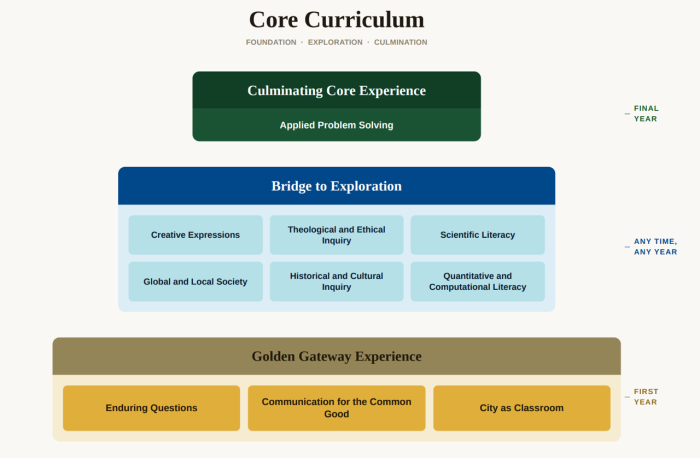
Core Curriculum at a Glance
The new Core is a “hybrid” model: a distinctive cross-disciplinary first-year experience, six distributive courses spanning the arts, humanities, sciences, and social sciences, and a culminating course centered on applied problem-solving. It leans into USF's Jesuit mission, both through learning outcomes threaded across each stage and through direct engagement with Jesuit concepts embedded in the Core's five Learning Goals: Communication and Collaborative Engagement (eloquentia perfecta), Scientific Reasoning/Information Literacy/Data-Driven Problem Solving, Critical Inquiry/Reflection/Ethics (cura personalis), Global and Local Citizenship (“people for others”), and Creative Expression and Innovation (magis). Four cross-cutting proficiencies, Community-Engaged Learning, Cultural Diversity, AI and Digital Proficiency, and Entrepreneurship for All Skills, run throughout the curriculum as well. The new Core comes in at 40 units total.
Golden Gateway
Golden Gateway is how USF students begin their academic journey: a three-course, two-semester sequence taken by all incoming students. Across the year, students wrestle with some of humanity's biggest questions, get out into San Francisco as their own living laboratory, and start finding their voice as communicators who can move people and make change.
- Enduring Questions is an interdisciplinary, humanities-based course in which students engage primary texts to wrestle with timeless questions of justice, freedom, truth, and the good life.
- City as Classroom is an interdisciplinary, experiential course open to any discipline, using the San Francisco Bay Area as a living laboratory through site visits, fieldwork, and research or creative projects.
- Communication for the Common Good explores how language, identity, and power intersect, building students' rhetorical, written, oral, and digital communication skills, including AI and media literacy, rooted in the Jesuit value of eloquentia perfecta.
Together, the three courses are designed to build community among students, help them find their footing, and begin building the intellectual toolkit they'll carry through the rest of their time at USF. Faculty teaching Golden Gateway courses complete a multi-meeting Jesuit Pedagogy workshop to help ground the sequence in USF's Jesuit tradition.
Bridge to Exploration
Bridge to Exploration is where students go wide. Through six distributive areas, Creative Expressions; Historical and Cultural Inquiry; Theological and Ethical Inquiry; Scientific Literacy; Quantitative and Computational Literacy; and Global and Local Society, students sample new ideas, sharpen skills that matter everywhere, and discover disciplines they didn't know they'd love. One semester might find a student tracing how literature and history have shaped the way we see ourselves; another might involve exploring creative expression through art or performance, examining the social forces that shape communities near and far, or taking on Bay Area ecology one semester and the ethics of AI the next.
Bridge to Exploration courses can double-dip with a student's major, helping manage overall unit load, and each area stays intentionally broad so students can follow their curiosity while still connecting back to the Core's shared learning goals.
Applied Problem Solving
In their final semesters, students put what they’ve learned to work. Applied Problem Solving is an interdisciplinary, project-based seminar open to any discipline, bringing students together from across the university to take on a real, complicated challenge facing the world today. Drawing on their major and their Core education alike, students research, create, and propose a grounded, evidence-based solution that matters.