2026 AI Symposium in Higher Education
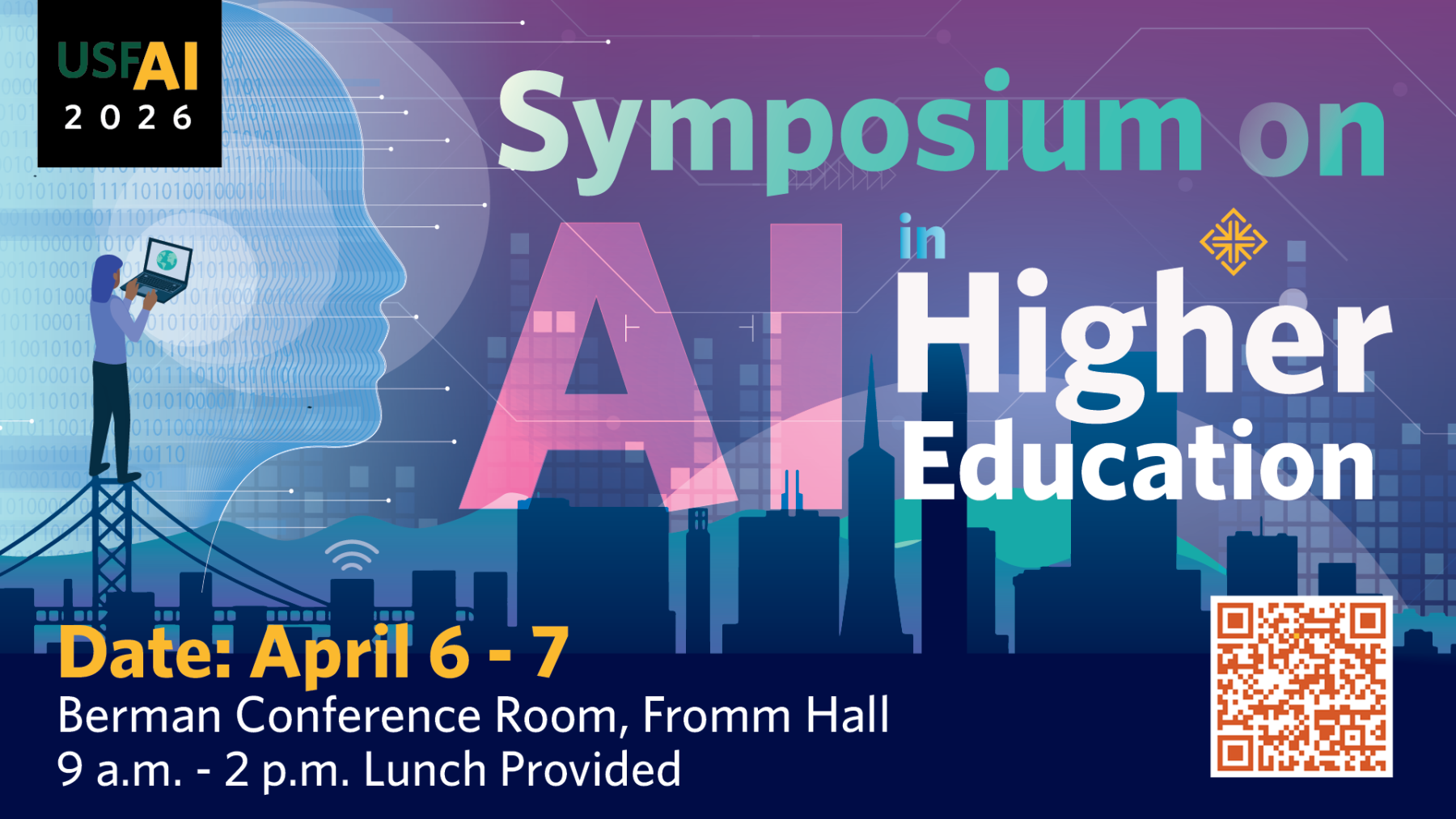 The third annual Symposium on AI in Higher Education is a collaboration between ETS/DLI, the Center for Teaching Excellence (CTE), and the Center for Research, Artistic and Scholarly Excellence (CRASE).
The Symposium provides an opportunity to discuss how AI can improve learning and teaching, and prepare students for a AI-driven world. The Symposium includes talks, panels, workshops, and presentations on topics like leveraging AI for classroom success, the ethical use of AI in education, enhancing learning outcomes using AI, and hearing from students on their experiences and expectations of AI on their learning and job readiness. The Symposium is aimed at understanding AI's benefits and challenges and sharing ideas on how to use AI to make education better for everyone. Join us as we learn from each other, and help shape how AI will influence the future of education at USF!
Berman
| Time | Presenter(s) | TitleS |
|---|---|---|
| 9:10–9:50 a.m. | Johanna Kalb, Dean, School Of Law |
Keynote: Disrupting Ourselves: Lessons Learned from USF Law's AI Curriculum Innovation |
| 10:00–10:30 a.m. |
Thomas Maier, Associate Vice Provost- Professional Education and Business Partnerships; and Camille Coley, Associate Vice Provost, Sponsored Programs and External Partnerships |
NSF-AI Ecosystem and External Partnership Capacity Building Description: The ASPIRE‑AI initiative positions the University of San Francisco to become a central, future‑ready partner in the rapidly evolving AI innovation ecosystem. Through a multi‑institution collaboration focused on building sustainable external partnerships, strengthening faculty capacity, and creating shared toolkits for industry engagement, ASPIRE establishes the institutional infrastructure USF needs to expand its role in Silicon Valley’s AI landscape. By developing centralized partnership structures, codifying outreach and collaboration processes, and leveraging cross‑sector insights the project lays a durable foundation for student opportunity. ASPIRE enables USF to connect students with applied AI research, experiential learning, and workforce pathways across healthcare, sustainability, data science, and emerging technology sectors. Grounded in USF’s Jesuit mission and proximity to leading tech and healthcare organizations, ASPIRE ensures that USF students—across disciplines—benefit from a more coordinated, equitable, and innovation‑driven ecosystem of AI partnerships. |
| 10:30–11:00 a.m. |
Kelly L'Engle, Associate Professor, SONHP; and Alark Joshi, Professor, Computer Science |
AI Health Coaching: An Interdisciplinary Model Bridging Computer Science and Health Description: In this presentation, we will describe the development of an AI health coaching chatbot, a collaboration between USF faculty and students from the public health and computer science departments. The chatbot was designed using a framework that aims for trust and transparency, personalization, and benevolence to foster a high degree of relational capacity and persuasive ability. Trained on transcripts from coaching conversations between human coaches and individuals in the Examen Tu Salud health and wellness program created by our team, the AI Chatbot uses Retrieval-Augmented Generation (RAG) to find similar responses and generate coaching conversation based on context. Early evaluation shows the AI Chatbot generates appropriate, supportive, and contextually-relevant responses. We will share lessons learned and student feedback from using the chatbot this spring to support health behavior change. |
| 11:00–11:15 a.m. | BREAK | |
|
11:15–11:45 a.m. |
Jonathan Cromwell, Assistant Professor of Entrepreneurship & Innovation, and Mana Azarm, Assistant Professor of Analytics and Information Systems |
Turning Students into Scholars: A New Pedagogical Approach with AI Description: This presentation introduces a new pedagogical approach that moves students beyond memorization and comprehension toward higher-order cognitive processing of application and synthesis — by using AI simulation to help students become mini-scholars in a related field to the course. By leveraging a new platform built at USF called PsycSim (psycsim.com), students do not simply recall what they've learned, but must also apply that knowledge to develop an effective theory that is run on simulated AI participants to produce extensive qualitative data and quantitative metrics. The presentation will provide a demo of this approach through a course on creativity and innovation, where students were challenged to take concepts learned throughout the course and synthesize them into an original, multi-step process such as problem formulation, ideation, feedback, revision, and evaluation. Students designed, iterated, and refined different processes using the platform, which culminated in a class-wide competition where each student's final design was replicated by the professor and graded on performance. By replicating the full scientific process on a small scale in the classroom—designing theories, testing hypotheses, interpreting data, revising their thinking in response to evidence, and seeing their work tested by others—students gain a deeper learning experience by becoming genuine experimentalists in a relevant topic of the course. |
|
11:45–12:15 p.m. |
Jill Ballard, Instructional Designer, Digital Learning and Innovation; Courtney Keeler, Associate Professor, SONHP, and Nora Onar, Associate Professor and Chair of Global Studies |
AI Literacy Opens Discussion: Building Collaborative GenAI Course Policies with Student Description: As instructors explore ways to engage students in critical, responsible thinking about GenAI and its uses, a primer on AI literacy may be the first step to open the discussion. This short presentation and panel bring together two instructors to share their experiences building collaborative course policies with students. Their accounts offer practical strategies and reflection, inviting colleagues to consider how framing a course GenAI policy can create trust and enhance the learning experience. |
| 12:15–1:00 p.m. |
Eugene Kim, Professor, School of Law; Edward Munnich, Professor, Psychology, and Kelsey Urgo, Assistant Professor, Computer Science |
Exploring the Effect Of GenAI On Cognition and Metacognition During Legal Reasoning Learning Description: Generative AI tools are rapidly transforming higher education, yet fundamental questions remain about their impact on student learning, cognition, and skill development. Our interdisciplinary team is conducting an experimental study examining how generative AI use affects law students’ legal reasoning, knowledge retention, metacognition, and written analytical performance. The study uses a counterbalanced experimental design in which students are randomly assigned to complete legal writing assignments both with (experimental condition) and without generative AI assistance (control condition). We measure multiple dimensions of learning, including the quality of legal analysis, students’ retention of relevant facts and legal reasoning immediately and over time, and their metacognition– how well they think they understood the material. Our research addresses the concern that generative AI may improve the apparent quality of written work while simultaneously weakening students’ cognitive engagement, metacognitive calibration, and long-term knowledge retention. In this presentation, we will share the following: We will frame these within broader questions currently facing higher education: We also hope this presentation will foster discussion and collaboration around future research, which may include the following: This presentation will be relevant to faculty across disciplines, instructional designers, and administrators seeking evidence-based strategies for integrating AI in teaching and assessment. |
|
1:00–2:00 p.m. |
LUNCH | |
Maier
| Time | Presenter(s) | TitleS |
|---|---|---|
| 9:10–9:50 a.m. | Johanna Kalb, Dean, School of Law |
Keynote: Disrupting Ourselves: Lessons Learned from USF Law's AI Curriculum Innovation |
| 10:00–10:20 a.m. |
Nicole Phillips, Associate Professor, School of Law |
Bounded by Design: Building Course-Specific AI Tools That Teach Skills, Not Shortcuts Description: How do we integrate AI into courses in ways that enhance learning rather than undermine it? This workshop demonstrates how to design custom AI tools that are bounded—deliberately constrained to support specific learning objectives while requiring students to do the intellectual work themselves. Using an Employment Law course as a case study, this session showcases two instructor-designed AI applications: a client interview chatbot that teaches fact-gathering skills, and a settlement negotiation simulation providing real-time practice. These tools were designed with intention—scoped to prompt student thinking rather than supply answers. The key insight: custom AI tools can be built around your course's specific needs. Rather than treating AI as an open-ended resource students might misuse, instructors can create bounded experiences that make critical thinking, verification, and judgment unavoidable. This approach addresses common faculty concerns. On ethical use: tools designed to ask questions rather than provide conclusions prevent students from copying outputs. On equity: instructor-designed tools ensure all students have equal access regardless of prior AI experience. Participants will see live demonstrations, examine design decisions, and draft specifications for bounded AI tools in their own disciplines. No technical expertise required—the goal is helping faculty articulate clear constraints and learning objectives that guide tool development. This session models what it teaches: using AI intentionally, within boundaries, to prepare students for professional environments where AI literacy is essential. |
| 10:20–11:00 a.m. |
TBD |
USF Alumni Working in AI Description: In this panel discussion, USF alumni will answer questions about their career journeys to leadership or supportive roles focused on AI. In today’s modern workplace, how can today’s students and educators keep pace? What skills do today’s students need to develop and master to be successful in today’s AI-centric workplace? Join five USF alumni for an inside look at the AI industry. Our panelists will trace their professional journeys from campus to the cutting edge of technology, sharing the pivotal moments that shaped their careers. |
| 11:00–11:15 a.m. | BREAK | |
|
11:15–11:45 a.m. |
Randy Souther, Librarian, Gleeson Library and Penny Scott, Reference Librarian, Gleeson Library |
Beyond Keywords: AI tools within Library Research Databases Description: AI-enhanced library databases are reshaping how researchers find scholarly articles and data. In this session, participants will explore new AI tools within Scopus (scholarly literature) and Statista (statistical data), learning how these systems generate focused, accurate results from curated sources. Unlike open-web chatbots, these tools operate within verified collections, offering a lower-risk approach to discovering relevant scholarly literature and statistics. Bring your laptop for this hands-on workshop. |
|
11:45–12:15 p.m. |
Arianna Costello and Nischal Divecha, with Katherine Edwards, moderator |
Student-led AI Initiatives: Building Engagement Through Research, Policy, and the City Description: This session will highlight new initiatives led by students that demonstrate how students want to be engaged in the decisions USF makes about AI use, and how you can support their opportunities on campus and in San Francisco. |
| 12:15–12:45 p.m. |
Nicole Evans, Jordan Atkins, Erika Buenrostro, Karisa Gingerich, and Henry Cunningham, School of Law, with Susan Zolezzi, moderator |
Developing AI Principles for USF Law Description: In this presentation, USF Law students will discuss the process they have conducted this year to develop principles to guide AI use at the School of Law. They will share the results of the survey they designed and conducted and the draft principles they've created for faculty review and adoption. |
|
1:00–2:00 p.m. |
LUNCH | |
Berman
| Time | Presenter(s) | TitleS |
|---|---|---|
| 9:10–9:50 a.m. |
Ryan Lufkin, VP of Global Academic Strategy at Instructure Canvas |
Keynote: Transforming Your Classroom with AI in Canvas Description: In this session, Ryan Lufkin, VP of Global Academic Strategy at Instructure, will discuss how leading institutions are leveraging Canvas AI features and market-leading AI solutions to reimagine the digital classroom. Leveraging AI to reduce educators' workload, speed up and strengthen feedback for learners, and deliver measurable gains in teaching and learning outcomes. |
| 10:00–10:30 a.m. |
Greg Benson, Professor, Computer Science
|
AI Agents in Action: From Fundamentals to Real-World Automation Description: AI agents represent the next frontier in artificial intelligence—moving beyond chatbots to autonomous systems that can plan, reason, and complete complex tasks with minimal human intervention. As this technology rapidly matures, agents are poised to become the 'new digital workforce,' fundamentally transforming knowledge work across industries and education. In this presentation, I will demystify how AI agents work, explaining their architecture and how they leverage LLMs to achieve autonomous task completion. Drawing on hands-on experience developing agents and multi-agent systems, I'll demonstrate live examples of agents in action and discuss practical implications for both industry and higher education. Attendees will leave with a clear understanding of this transformative technology and its potential applications in their own work. |
| 10:30–11:00 a.m. |
Jill Ballard, Instructional Designer, Digital Learning and Innovation; and Faculty Panel |
Projects in Practice: Faculty Share Discoveries from their GenAI-Integrated Assignments Description: As a culminating project for the ETS GenAI Certificate, many faculty have developed student-facing assignments that employ GenAI in thoughtful, responsible ways. These assignments incorporate the knowledge and skills gained through the program, tailored to meet the instructional needs of their disciplines. Whether newly created or adapted from existing coursework, the true test comes when students complete these assignments in a real course context. This panel brings together faculty who have put their projects into practice, to share their discoveries and thoughts about future academic GenAI integrations. |
| 11:00–11:15 a.m. | BREAK | |
|
11:15–12:00 p.m. |
Nicole Gonzalez Howell, Associate Professor, Rhetoric and Language, Co-Director, CTE |
Listening Session for AI and the Core Description: Come be part of the process of developing an AI Core Competency at USF. In this collaborative working session, faculty and staff from across disciplines will co-create a shared AI Competency Framework applicable to any undergraduate major. Drawing on a foundational structure with two key dimensions — proficiency levels (Literacy, Fluency, and Mastery) and domain-specific applications of AI — participants will work together to populate a framework grid with drafts of concrete learning outcomes and real major-specific examples. By the end of the session, the group will have a validated, field-adaptable framework and a roadmap for pilot implementation and broader university sharing. |
| 12:00–12:50 p.m. |
Allison Dulin Salisbury, Co-Founder & CEO, Humanist |
Keynote: A Fireside Chat with Allison Dulin Salisbury |
|
1:00–2:00 p.m. |
LUNCH | |
Maier
| Time | Presenter(s) | Title |
|---|---|---|
| 9:10–9:50 a.m. |
Ryan Lufkin, VP of Global Academic Strategy at Instructure Canvas |
Keynote: Transforming Your Classroom with AI in Canvas |
| 10:00–10:30 a.m. |
Eric Lacy, Faculty, School of Management |
Building with AI: How I Use GenAI to Develop My Canvas Courses Description: This workshop demonstrates how a faculty member uses GenAI to build and manage Canvas LMS courses through a practical copy-and-create workflow. Attendees will see live examples of AI-assisted course development: drafting module structures, writing assignment descriptions and rubrics, generating interactive learning materials, composing targeted student communications, and producing visual aids like diagrams and planning tools. The session focuses on the craft of prompting, that is how to give AI enough context to produce usable, course-ready output on the first or second pass. Participants will leave with a repeatable workflow they can apply to their own courses immediately, no technical background require |
| 10:30–11:00 a.m. |
Allison Thorson, Professor, Communication Studies
|
AI Prompting Description: Prompt engineering is the practice of designing and refining inputs (prompts) to guide AI models, like ChatGPT, toward generating the most useful and accurate responses. It involves understanding how language models interpret instructions and experimenting with phrasing, context, or structure to optimize outputs. In essence, it’s about learning to “speak the model’s language” so it performs better for a given task. This session will highlight techniques such as Zero Shot prompting, Few Shot Prompting, and other key components of effective prompts. |
| Victor Palacios, Director, Data Science and Artificial Intelligence Partnerships (10:45-11:00 a.m.) |
Why everyone should learn to Vibe Code Description: I'll go over historic cases of bad AI (e.g., Gemini telling users to kill themselves) and bad Vibe Coding (e.g., deleting entire drives), but I will ultimately argue that students should use AI and they should Vibe Code but with guardrails. |
|
| 11:00–11:15 a.m. | BREAK | |
|
11:15–11:45 a.m. |
Khulan Zagd, Assistant Director, The Learning Center |
AI Usage Among Learning Center's Peer Leaders and Students They Work With Description: This presentation will share findings from a Generative AI usage survey conducted by the Learning Center among its peer leaders in February 2026. The survey included ten questions designed to explore which AI tools student staff use, how frequently they rely on them, and how AI supports their preparation for tutoring or coaching sessions. It also examined whether students discuss AI during sessions and how peer leaders perceive students’ current uses of these tools. In addition, the survey gathered insights into peer leaders’ comfort levels discussing ethical and appropriate AI use, as well as the challenges they observe in academic work related to AI. The session will highlight key trends, identify training needs for peer leaders, and discuss how learning centers can better support responsible and informed use of Generative AI in peer-to-peer academic support. |
|
11:45–12:00 p.m. |
Kara Scanlon, Disability Specialist, Student Disability Services |
AI Usage in Student Disability Services Description: The session will highlight the assistive technology with AI that SDS uses to accommodate students at USF. It will talk about the training needed for students to use the programs successfully and the support these tools bring to the students who use them in SDS. This presentation will share data about the usage of students of SDS as well as other tools students can use. We will discuss the use of AI for ADA accommodations and AI that can help any student support their learning or executive functioning. |
| 12:00–12:50 p.m. |
Allison Dulin Salisbury, Co-Founder & CEO, Humanist |
Keynote: A Fireside Chat with Allison Dulin Salisbury, Co-Founder & CEO, Humanist |
|
1:00–2:00 p.m. |
LUNCH | |